

The annual AC maintenance contract cost in Dubai depends on the property’s cooling systems, the work included, and the service schedule. An apartment and a villa may need different plans because their equipment and maintenance requirements differ.
A yearly contract can organize routine servicing, but its value depends on the tasks and visits it covers. This guide explains common maintenance tasks, how preventive care supports system upkeep, and what to consider when reviewing a contract.
The guide also explains how maintenance needs differ across apartments, townhouses, villas, and commercial properties. Use these details to identify the service scope that best fits your building.
Key Takeaways
- Review the visit schedule, maintenance tasks, and emergency response terms to understand what an annual AC plan covers.
- Preventive servicing helps identify developing issues and supports reliable system operation.
- Choose a provider whose maintenance process and contract terms suit your AC equipment and property needs.
- Use your property type, number of AC units, and system design to understand why contract requirements vary.
What's included in your home A/C maintenance service?
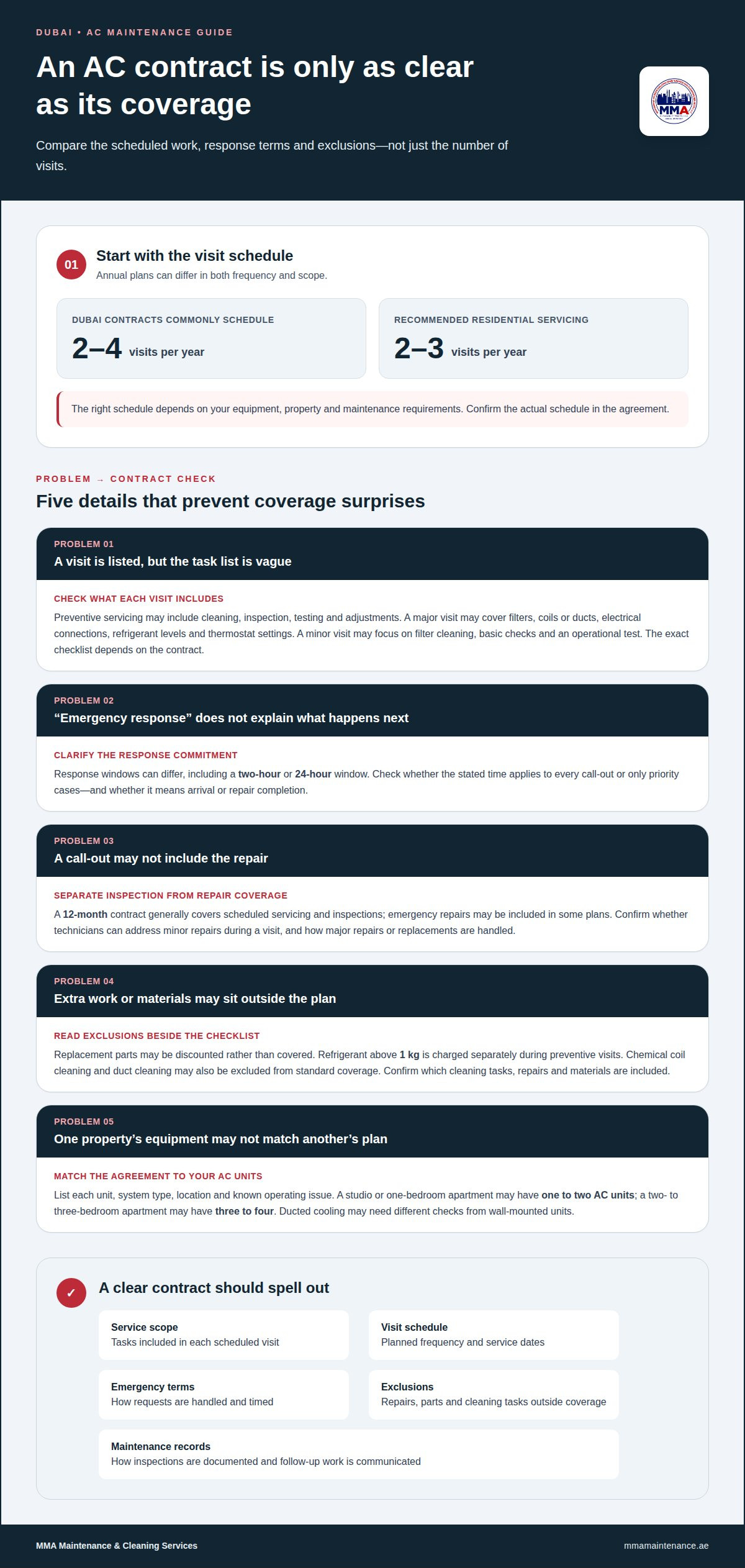
Dubai AC contracts commonly include 2-4 scheduled visits per year; residential systems are recommended to receive 2-3 service visits yearly. Emergency call-outs and repairs depend on contract coverage; refrigerant above 1 kg and replacement parts may be charged separately.
Preventive maintenance and scheduled servicing
Preventive visits may include cleaning, inspection, testing, and adjustments to identify faults before they cause a breakdown. A major visit may cover filters, coils, or ducts, electrical connections, refrigerant levels, and thermostat settings. A minor visit may focus on filter cleaning, basic checks, and an operational test. The exact checklist depends on the contract.
Visit frequency and emergency response
Across Dubai, contracts typically schedule 2-4 visits annually, while recommended residential servicing is 2-3 visits per year. A service-level agreement should state the visit schedule and how emergency requests are handled. Response commitments can differ, including a two-hour or 24-hour window. Check whether the stated window applies to every call-out or only priority cases, and whether it covers arrival or repair completion.
Emergency call-outs and repair coverage
A 12-month contract generally covers scheduled servicing and inspections, while emergency repairs may be included in some plans. The agreement should distinguish a call-out from the repair itself: technicians may inspect the AC system, identify the fault, and explain which work falls within coverage. Minor repairs may be addressed during a visit; major repairs or replacements can require separate appointments.
Contract exclusions and parts coverage
Read exclusions alongside the maintenance checklist. Replacement parts are commonly discounted rather than covered, so a failed component may involve a separate charge. Refrigerant gas above 1 kg is charged separately during preventive maintenance visits. Chemical coil cleaning and duct cleaning may also sit outside standard coverage. Confirm which cleaning tasks, repairs, and materials are included before comparing contract scopes.
What are the benefits of an annual maintenance contract?
An annual contract makes AC care a planned process rather than a response to breakdowns. During each visit, technicians can record the system’s condition, identify recurring faults, and note follow-up work. This history helps distinguish a new issue from a repeat problem and gives property decision-makers a clearer record of maintenance completed during the year.
For homeowners, preventive maintenance can support consistent cooling and help identify equipment issues before they disrupt daily routines. Landlords can use visit records to document upkeep between tenancies, while tenants benefit when systems receive routine attention. For example, a report noting restricted airflow gives the responsible party a clear starting point for arranging filter cleaning or further inspection.
Regular care also helps technicians spot conditions that may affect operation, such as dirty filters, obstructed outdoor units, or unusual system noise. Addressing these findings can reduce the risk of avoidable breakdowns and support efficient air conditioning performance. Maintenance does not replace correct installation, but inspection can identify operating concerns that need attention after installation or during regular use.
An annual package can simplify planning by organizing visits and follow-up through one agreement. Before choosing a plan, consider which systems need attention, how records will be shared, and how urgent requests are handled. Clear maintenance records help homeowners, landlords, and facilities teams coordinate decisions without relying on memory or scattered work orders.
For related property upkeep, you can explore maintenance support alongside your building’s routine service planning.
Choosing an AC maintenance provider
Choose a provider whose maintenance process and contract terms match your AC equipment and priorities.
Matching contract terms to needs
Start by listing each AC unit, its system type and location, and any known operating issues. A home with ducted cooling may need different checks from one with wall-mounted units. Match preventive tasks to the systems, then clarify which work is routine servicing and which is handled separately.
Look beyond the visit schedule. Check how findings are recorded, how follow-up work is communicated, and how repairs beyond routine maintenance are treated. Coil cleaning, electrical checks, and parts can affect the scope. A suitable plan should reflect your property’s equipment and maintenance priorities.
Checking provider licensing and contract terms
Dubai residents can review the company’s trade licence and business details, then compare the listed activity with the AC maintenance work being offered. The contract should identify the service scope, scheduled visits, exclusions, and process for additional work. Keep the licence details and signed agreement with your property records.
Read each clause defining preventive maintenance and repair coverage. Check, for example, whether coil cleaning is a standard task or separate work, and whether an AC unit’s electrical fault falls within maintenance or requires a separate repair. The contract should explain how inspections are documented and recommendations communicated.
Before signing, compare the agreement with your equipment list and ask for unclear terms to be stated plainly in the contract. Check its start and end dates, renewal process, and how service requests are recorded. For landlords, shared records help coordinate access and maintenance between occupants. For facilities teams, consistent reports make it easier to track work across multiple systems.
Annual AC maintenance by property type
Dubai properties vary in AC equipment, unit count, system design, and maintenance workload. These factors shape the service schedule and the checks each building needs. A studio apartment with split units has different requirements from a villa with ducted systems.
A studio or one-bedroom apartment may have one to two AC units. A two- to three-bedroom apartment may have three to four. Townhouses and small villas can have four to six units, while large ducted villas may involve more complex systems. Unit count helps organize visits, but equipment design and access also affect the work.
- Studio or one-bedroom apartment: Identify each unit and its type, then map the required cleaning and inspection tasks.
- Two- to three-bedroom apartment: Several units may need coordinated servicing and system checks.
- Townhouse or small villa: Different indoor zones and multiple units can require a wider maintenance schedule.
- Large or ducted villa: System design, equipment access, and the number of connected components shape the maintenance plan.
Commercial properties require planning around system scale and building operations. Quarterly preventive maintenance, or four visits per year, is stated as the industry standard for commercial properties in Dubai. Some commercial AC systems need monthly servicing during summer. Operating schedules and system use help determine the appropriate approach.
Other planning factors include refrigerant requirements, coil cleaning, emergency response terms, and replacement-part coverage. Indoor conditions, outdoor exposure, inspection depth, and system design also affect the work. Buildings with different AC types may need separate tasks for each system.
To plan maintenance by property type, list the AC units, note each system design, and align visits with how the building is used. This gives homeowners and facilities teams a clearer basis for setting priorities and coordinating routine upkeep.
MMA Maintenance & Cleaning Services
MMA Maintenance & Cleaning Services supports residential and commercial properties in Dubai. For property work alongside AC planning, the team provides Electrical, House Cleaning, Facade Cleaning, and Painting. These services can help coordinate related upkeep while keeping their scope distinct from the AC contract.
Use this guide to define your AC requirements, including scheduled visits, inspection tasks, and repair exclusions. For other building work, MMA Maintenance & Cleaning Services offers a single point of contact to coordinate relevant services. This is useful when planning several types of property maintenance and seeking clear communication about each task’s scope.
Contact MMA Maintenance & Cleaning Services to discuss the property work you need and request a quotation.
Make your maintenance plan work for your property
Use your AC requirements to shape a practical maintenance plan, then keep the agreed scope and service records with your property documents. These records provide a reference when systems change, occupants move, or future maintenance needs arise. Annual AC maintenance contract cost in Dubai is only one part of the decision; a clearly defined scope shows what the arrangement is intended to cover.
MMA Maintenance & Cleaning Services also supports property work that can sit alongside routine AC planning, including Electrical, House Cleaning, and Facade Cleaning. Its practical approach and clear communication help organize separate tasks. Discuss the work you want coordinated and choose support that fits your property’s needs.
For a straightforward next step, contact MMA Maintenance & Cleaning Services and describe the property work you need. A clear starting point can make the next maintenance decision easier to manage.
Frequently Asked Questions
What is an AMC contract?
An AMC, or annual maintenance contract, is an agreement for planned AC servicing over a defined term, commonly 12 months. It sets out the systems covered, scheduled work, and how service requests are handled. For example, an agreement might cover maintenance for the apartment’s listed AC units but treat upgrades or replacement equipment as separate work.
Which services are included in major visits?
A major visit may involve a broader AC system inspection, including filters, coils, ducts, electrical connections, refrigerant levels, and thermostat settings. Technicians may also assess indoor air quality and outdoor compressor performance. The visit record should link each finding to the action taken, such as cleaning a blocked filter or noting a component for follow-up.
Why aren't duct and coil cleaning included in the residential AMC?
Duct cleaning and chemical coil cleaning are often separate from routine servicing because they involve distinct tasks and scope. A standard visit may include a basic inspection or filter cleaning without deep cleaning inside ducts or coils. Look for these tasks by name in the agreement to distinguish routine maintenance from additional cleaning.
Are there any extra costs homeowners should be aware of?
Yes. Refrigerant gas above 1 kg is charged separately during preventive maintenance visits, and replacement parts are often discounted rather than covered. Duct cleaning and chemical coil cleaning may also fall outside routine contract work. For example, a technician may identify a worn component during inspection, while the part and any related repair are handled separately.
Can the contract be transferred if I move to a new location?
Whether a contract can transfer depends on its terms and the equipment covered. A contract tied to specific AC units or a named property may not automatically apply to another home. Before moving, review clauses on address changes, covered equipment, and remaining visits. A new apartment with a different system type, for example, may need revised coverage rather than a simple transfer.
Do I need an AC AMC in a district cooling apartment?
Possibly, but the relevant equipment differs from an apartment with its own cooling unit. District cooling supplies chilled water to the building, while in-home equipment such as a fan-coil unit, thermostat, and airflow components may still need maintenance. Identify which equipment serves your apartment and which belongs to the building system to determine what coverage is relevant.


