

Dubai’s heat and prolonged air-conditioning use can place sustained stress on AC capacitors, which help start and run the system’s motors. When a capacitor weakens, you may notice delayed or difficult startup, humming, a fan that does not run, unexpected shutdowns, or warm air from the vents.
If your AC is blowing warm air, a capacitor problem is one possibility, but other faults can cause similar symptoms. Understanding AC capacitor failure symptoms and the right fix in Dubai starts with knowing what the signs may mean and why the cause should be diagnosed before any part is replaced.
This guide explains how capacitor problems can affect cooling, what a safe repair involves, and when to arrange professional HVAC maintenance for your home or commercial property.
Key Takeaways
- Notice delayed startup, humming, frequent shutdowns, or an outdoor fan that does not spin; these can point to a capacitor problem.
- Warm air may be linked to a failing capacitor, but other cooling faults can produce similar symptoms.
- A proper diagnosis checks the capacitor alongside related electrical components before deciding on a replacement.
- If the outdoor fan stops or the AC repeatedly struggles to start, switch the unit off and arrange a professional assessment.
How do you know a capacitor has failed?
A weak capacitor can stop the compressor or fan motor from starting correctly. In Dubai, humming, delayed startup, or a tripped breaker can point to a fault, but testing is needed to identify the cause.
Capacitor testing involves electrical components, so do not open the outdoor unit yourself. A technician can use a capacitance meter and multimeter to assess capacitance, voltage, wiring, and related components.
Compressor and Motor Starting Problems
The capacitor helps start and run AC motors. If it loses capacitance, the compressor may struggle to start, fail to start, or stop unexpectedly. A faulty fan capacitor can also prevent the outdoor fan motor from running.
For diagnosis, a technician checks capacitance and related electrical connections before deciding whether replacement is needed. A compressor that hums without starting needs attention, not repeated restart attempts.
Starting Torque and Sluggish Startup
The capacitor helps provide the starting force, or torque, needed to get a motor moving. When its capacitance drops, the compressor may start slowly or fail to overcome the initial resistance. You may notice a delay between switching on the AC and hearing it run.
Technicians compare the capacitor’s reading with its rating. For a 45-microfarad capacitor, the stated approximate acceptable range is 42 to 48 microfarads. They also inspect wiring and other electrical components before recommending replacement.
Humming Outdoor Unit
A humming sound from the outdoor unit can mean a motor is receiving power but struggling to start. A failed capacitor is one possible cause, but humming alone does not confirm it. A fan that does not spin is another reason to switch the AC off and arrange an assessment.
Replacement involves isolating power, checking the capacitor and connections, fitting one with an exact microfarad match and an equal or higher voltage rating, then testing operation. If cooling remains weak, refrigerant or another fault may need a separate diagnosis.
To help prevent repeat problems, keep the outdoor unit clear of obstructions and arrange maintenance if startup becomes sluggish. AC capacitors in Dubai typically last 3 to 7 years. For urgent symptoms, switch off a unit with a stationary fan and seek a repair service. Before hiring, look for a clear diagnosis, correct component matching, and post-repair testing.
Looking for signs of a bad AC capacitor?
An AC that stays off may have a failed capacitor, but that is not the only possible cause. In Dubai, a tripped breaker, blown fuse, thermostat fault, or motor issue can also prevent startup.
AC Failing to Turn On
Note what happens when you switch the AC on: does it remain silent, start briefly, or make a sound without running? A faulty capacitor can stop the compressor or fan motor from starting, while a breaker trip may point to another electrical fault.
Check the breaker and reset it if needed. If it trips again, or the unit still will not start, switch the AC off and arrange a technician’s assessment. Repeatedly resetting a breaker or trying to start the unit will not identify the failed component.
Buzzing Noises and Continued Operation Risks
A buzzing outdoor unit can indicate a failing capacitor, particularly if the fan does not run or the compressor does not start. The sound alone cannot confirm the cause. A technician can test the capacitor, wiring, and related electrical components before deciding on a repair.
Continued operation with a faulty capacitor can put extra strain on motors and other electrical parts. If the outdoor fan is stationary, turn the AC off; the compressor can overheat within minutes. This can help limit further damage while you arrange an assessment.
Cleaning a filter may help with restricted airflow, but it will not repair a capacitor or resolve a breaker fault. If the AC remains off after checking the breaker, leave internal electrical testing to a technician. A professional assessment can distinguish a capacitor fault from thermostat, fuse, or motor problems.
For persistent electrical issues affecting your AC, ask about Electrical support as part of the repair process.
Capacitor failure as a cause of warm air
A failing capacitor can interrupt cooling by preventing a motor from starting or running properly. Warm air is a useful symptom, but it does not identify the fault on its own.
Warm Air from the Vents
If the compressor or condenser fan cannot operate correctly, the AC may not remove heat as expected. You may feel warm air at the vents even though the thermostat is set to cool. Note whether the airflow continues and whether the air changes temperature after startup.
A technician can test the capacitor’s capacitance and inspect related electrical components. If the capacitor tests within its rated range, the assessment can consider other causes, including low refrigerant, dirty coils, blocked filters, or thermostat problems.
Warm Air and Premature Shutdown
A weak capacitor can contribute to short cycling, when the AC starts and stops repeatedly before maintaining the set temperature. Cooling may fade between cycles, leaving the room warm despite continued air-conditioning use.
Record when the shutdown occurs: shortly after startup, after cooling for a while, or at irregular intervals. That detail helps distinguish a repeated operating problem from a unit that simply runs during Dubai’s summer heat. Outdoor temperatures can regularly exceed 45°C in summer, adding to cooling demand.
Warm air can also result from faults unrelated to the capacitor. A technician can check the electrical system, condenser operation, airflow, refrigerant, and thermostat rather than replace a component based on vent temperature alone. The findings guide the repair and help confirm whether the AC cools steadily afterward.
If the AC repeatedly shuts down or blows warm air, turn it off if you notice unusual operation and arrange an assessment. Avoid repeated restarts as a substitute for diagnosis. A clear record of temperature changes, shutdown timing, and cooling performance gives the technician useful details for locating the fault.
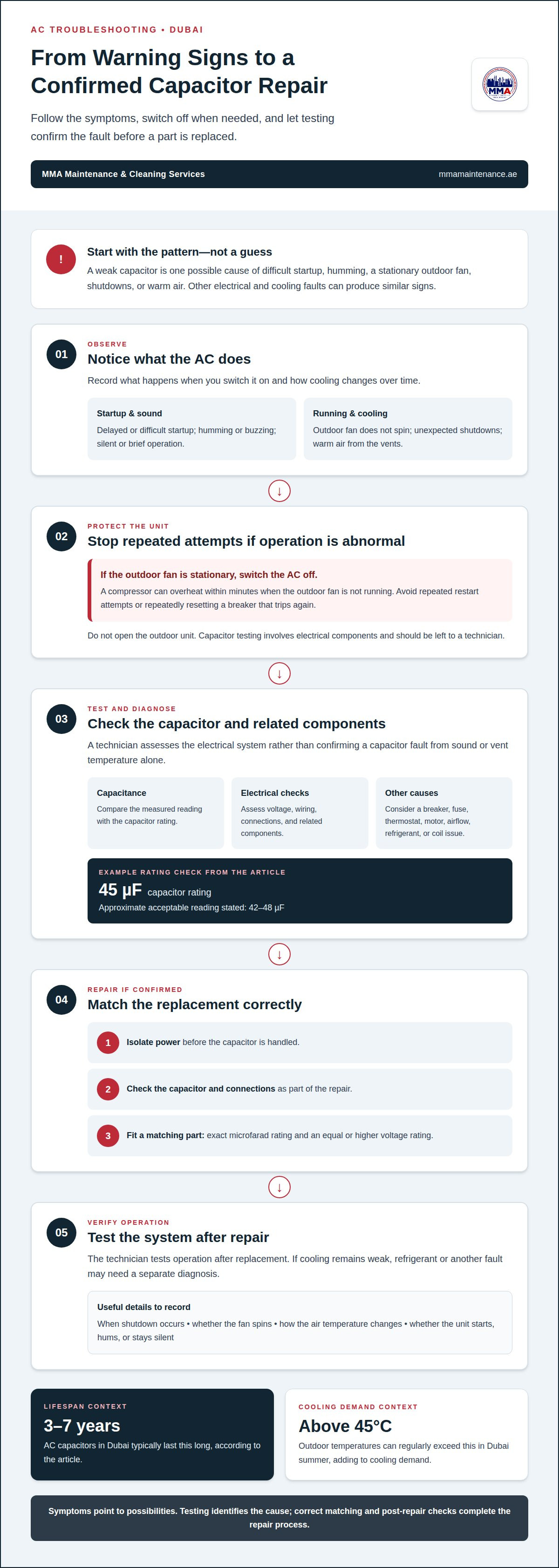
AC capacitor failure symptoms
Recognizing AC capacitor failure symptoms and finding a fix in Dubai starts with observing how the system behaves. A slow start, intermittent operation, weak airflow, or cooling that stops can point to a capacitor fault, but each can also have another cause.
- Note whether the AC starts promptly or struggles to begin.
- Observe whether the outdoor fan runs during cooling.
- Record if airflow or cooling changes before the system stops.
- Notice whether the thermostat setting matches the selected operating mode.
These observations help describe the problem, but they cannot confirm which component has failed. A thermostat issue may affect system operation, while restricted airflow or low refrigerant can reduce cooling. The distinction matters because replacing a capacitor will not resolve a separate fault.
A technician can measure capacitance against the component’s rating, inspect wiring, and assess related electrical parts. If the capacitor is faulty, its replacement must match the required microfarad rating and have an equal or higher voltage rating. The technician can then test startup and operation to see whether the original symptom remains.
For a clear diagnosis of AC capacitor failure symptoms and a fix in Dubai, share the sequence of events, not just the final symptom. Mention whether the unit starts, how the fan behaves, and when cooling changes. If the outdoor fan stops, switch off the AC rather than repeatedly restarting it. This helps limit added strain while the fault is assessed.
If symptoms continue after repair, a further assessment can help identify an unresolved or separate issue. Request an AC repair assessment for recurring startup or cooling problems.
MMA Maintenance & Cleaning Services
MMA Maintenance & Cleaning Services supports property owners and facilities teams with practical maintenance and building work. If an AC assessment identifies an electrical issue, its Electrical service can help address related electrical work within the property. A clear diagnosis helps define the next step and keep unrelated tasks separate.
For property needs beyond this AC concern, the team also provides House Cleaning, Facade Cleaning, and Painting. These services support other aspects of property care and are separate from diagnosing a capacitor fault.
Contact MMA Maintenance & Cleaning Services to discuss the work your property needs.
Plan the next step for your property
When an air conditioner starts behaving differently, note what you observe before arranging service. Include whether the unit starts, how the airflow changes, and whether it shuts down during operation. These details give the technician a useful starting point and help keep the assessment focused on the fault.
For AC capacitor failure symptoms and a fix in Dubai, choose a professional assessment rather than opening the electrical compartment yourself. MMA Maintenance & Cleaning Services provides property support through its Electrical service. For separate building needs, the team also provides House Cleaning, Facade Cleaning, and Painting.
A measured diagnosis is a practical next step for your home or commercial property. It can clarify what needs attention and what work should follow, without treating every cooling problem as the same fault.
Contact MMA Maintenance & Cleaning Services to discuss the work your property needs. A clear description of the issue is a good place to begin.
Frequently Asked Questions
Why do capacitors fail so often in Dubai?
Dubai’s summer heat and sustained air-conditioning use can place prolonged stress on capacitors. Outdoor temperatures regularly exceed 45°C in summer, while AC systems are used year-round and peak demand lasts 6-8 months. Electrical surges and ageing components can also contribute. These factors help explain why capacitor faults may arise, but they don’t mean every cooling problem has the same cause.
Can a capacitor be repaired instead of replaced?
An AC capacitor is generally replaced when testing shows it has failed or fallen outside its rated capacitance range. Repairing the damaged component itself is not the usual solution. A technician should first check the capacitor and related electrical components, since a wiring fault or another system issue may cause similar symptoms. Replacing a capacitor without identifying the underlying fault may not resolve the AC problem.
What are the symptoms of a failing AC capacitor?
A failing capacitor may leave the AC slow to respond, unable to maintain cooling, or prone to irregular operation. You might also notice an unusual sound from the outdoor unit or a change in how the fan behaves. Look at the pattern across the system, such as whether cooling changes after startup or the thermostat setting remains unmet. These signs call for diagnosis, not a visual guess.
How can you tell if an AC capacitor is faulty or the compressor has failed?
Symptoms can overlap, so sound or startup behavior alone cannot distinguish a capacitor fault from compressor failure. A technician measures the capacitor’s capacitance and checks wiring and related electrical components. If those checks do not explain the problem, the compressor needs assessment as part of the diagnosis. This process helps identify whether the capacitor, compressor, or another electrical fault is preventing normal operation.
What causes AC capacitors to fail in Dubai's heat and humidity?
High outdoor temperatures, prolonged system stress, electrical surges, and ageing components can all contribute to capacitor failure. In Dubai, extended AC use adds operating demand, particularly during hot periods. Humidity alone does not establish that a capacitor has failed. The unit’s operating history and electrical condition matter too, so diagnosis should consider the capacitor alongside the system’s wiring and other components.
What capacitor ratings and specifications must match when replacing one?
The replacement capacitor must have an exact microfarad match and an equal or higher voltage rating. Its type also needs to suit the AC’s design, such as start, run, or dual. A technician can compare the existing component’s markings with the system requirements and check its connections. Incorrect ratings or an unsuitable type can prevent the motor from operating as intended.


